
Abbott Fuller Graves is often remembered as a painter of flowers, but the garden paintings reveal a broader interest. Flowers, doorways, walls, paths and windows are repeatedly brought into the same space, and it is this relationship between cultivated nature and architecture that gives many of his paintings their particular character.
Among these works, Doorway and Garden is especially revealing. The subject sounds simple, yet the painting depends on the meeting of two different kinds of space. The doorway belongs to the house, with its solid wall and enclosed interior, while the garden extends beyond it into sunlight and vegetation. Graves uses the boundary between them as an important part of the composition.
A doorway in his work is therefore more than an architectural feature. It gives the viewer a place from which to enter the scene.
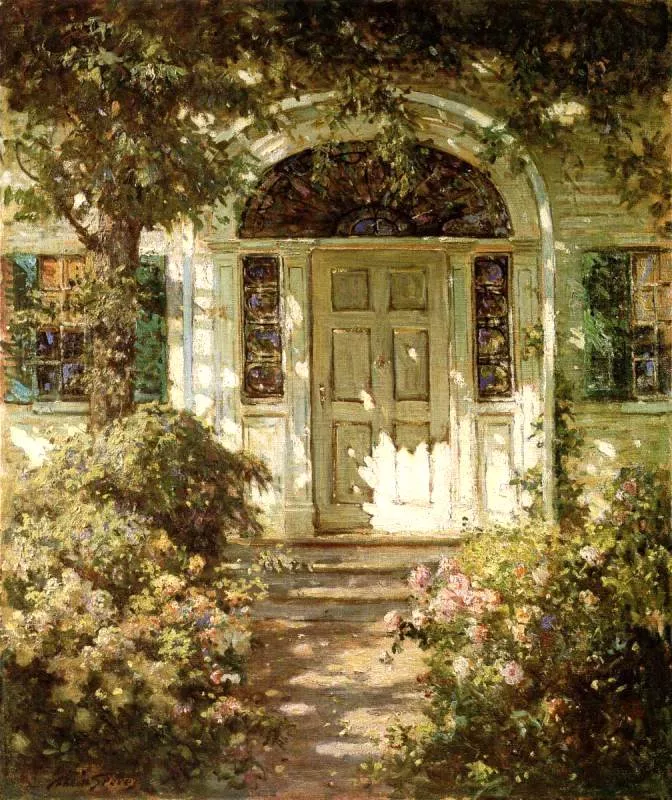
In The Doorway, the darker architectural area makes the garden beyond it appear brighter. The contrast is straightforward but effective, because the eye naturally moves from the shaded structure toward the flowers and foliage outside. Graves does not need a dramatic landscape or a distant horizon to create a feeling of depth. A wall, an opening and a carefully arranged garden are enough.
This way of organizing a picture is closely connected with Graves's background. Before concentrating on painting, he studied architecture at the Massachusetts Institute of Technology, and the influence of that training can be seen in the way he arranged buildings and garden spaces. Even when flowers occupy much of the canvas, there is usually an underlying order holding the composition together.
That order is particularly noticeable in his treatment of courtyards and entrances. A doorway establishes a vertical element, a wall creates a firm plane, and plants soften those geometric shapes without destroying them. Vines, branches and flowers may cross the architectural forms, but the structure remains visible beneath them.
The result is quite different from a landscape in which nature is allowed to dominate completely. Graves's gardens are made spaces. They belong to houses, terraces and courtyards, and they suggest the presence of people even when nobody appears in the painting.
His interest in flowers developed alongside this architectural sensibility. In works such as Pink and Red Roses, the flowers become the principal subject, yet Graves still treats them as an arrangement of shapes, colors and textures rather than as a botanical catalogue. The dense grouping of blossoms gives the picture its visual weight, while the darker foliage behind them provides enough contrast for the individual flowers to remain distinct.
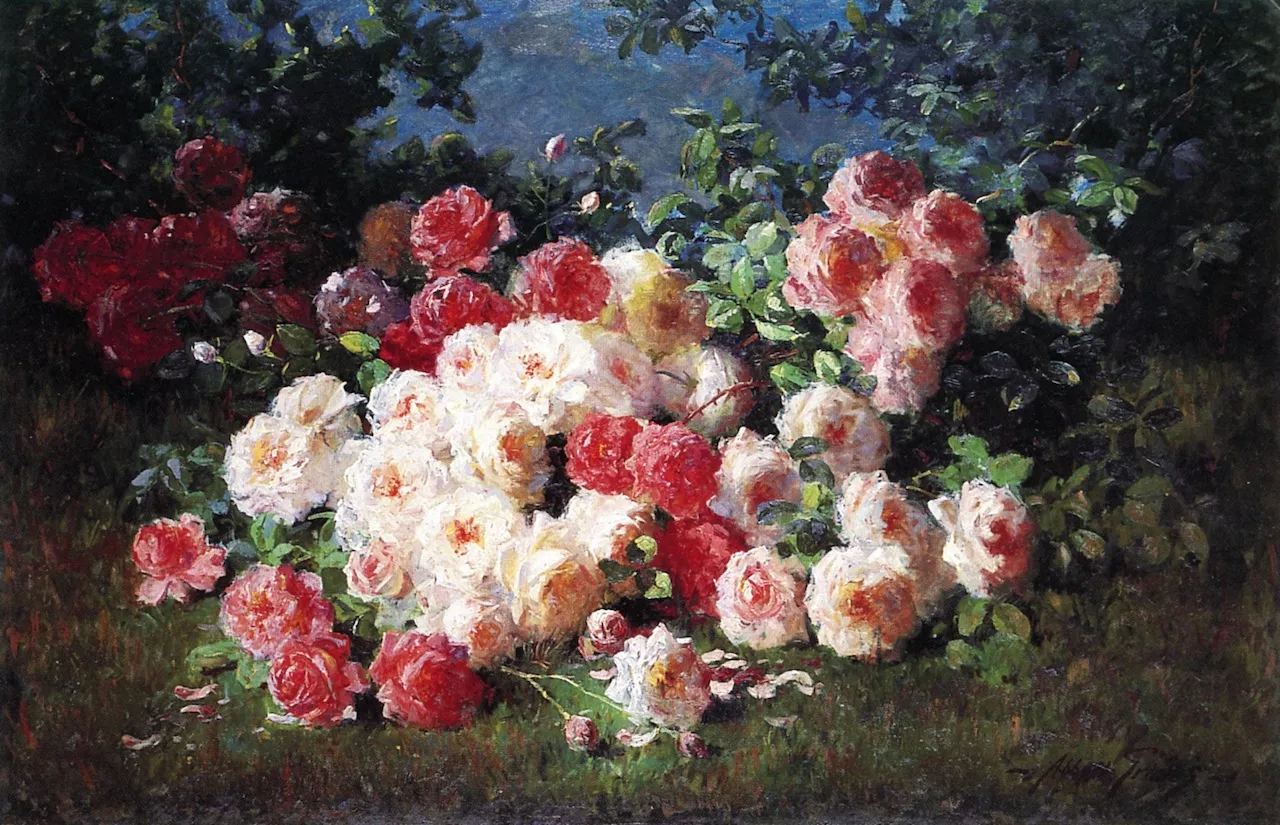
Roses appear frequently in the history of garden painting because they offer an unusually rich range of color and form, and Graves understood their value as pictorial material. Pale petals can catch sunlight differently from deep red ones, leaves introduce darker passages, and the irregularity of the flowers prevents the composition from becoming too rigid.
There is also a useful connection between his flower paintings and his larger garden scenes. In both, Graves was interested in cultivated abundance. Whether the flowers are gathered into a close arrangement or growing beside a doorway, they are part of a designed environment in which color has been shaped by human attention.
This helps explain why his paintings of gardens can feel quite different from the wilder landscapes produced by many nineteenth-century painters. The spaces are not untouched pieces of countryside. They are gardens in the proper sense of the word, places where architecture, planting and daily life meet.
Graves's European experience contributed to this vocabulary. He travelled abroad during the 1880s and studied painting in Europe, where he developed his interest in flower painting and encountered the artistic developments that were changing the treatment of light and color. Yet the subjects that became central to his mature work were not confined to Europe.
American settings offered their own possibilities, particularly in places where architecture and vegetation created strong contrasts. New Orleans, with its courtyards, shutters, walls and distinctive domestic architecture, provided a rich environment for an artist interested in precisely this relationship.
The appeal of such scenes lies partly in their scale. Graves did not need a monumental building to create a strong composition. A doorway could be enough. A garden wall could establish the perspective. A small courtyard could contain all the contrasts he needed between light and shade, solid architecture and soft vegetation.
This is also why his paintings reward close looking. From a distance, a Graves garden may first appear to be a pleasant arrangement of flowers and sunlight. Looking longer reveals the structure underneath. The position of a doorway determines where the eye enters the scene, a wall controls the balance between light and shadow, and a cluster of roses can connect the foreground with the architectural setting behind it.
His American Impressionist qualities are most apparent in this treatment of light. Graves was interested in the changing appearance of outdoor surfaces, particularly the way sunlight could alter a wall, a path or a group of flowers. But he did not allow light to erase the identity of the objects within the scene. Architecture remains architecture, flowers remain flowers, and the garden retains a recognizable physical structure.
That combination gives the paintings a distinctive balance. There is enough observation to make the places convincing, but enough design to prevent them from becoming merely descriptive.
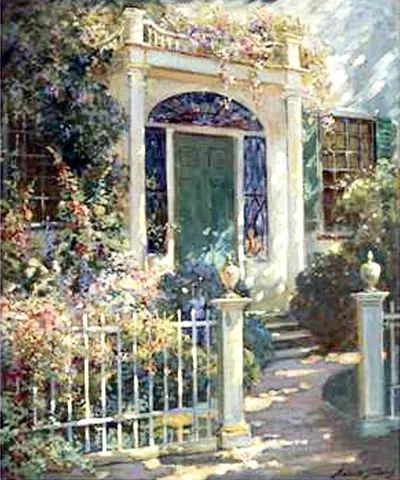
Doorway and Garden can be understood in this context as more than a single garden subject. It brings together several concerns that run through Abbott Fuller Graves paintings, including architecture, flowers, cultivated outdoor spaces and the movement of light across them. The doorway provides the organizing element, while the garden supplies the variety of color and texture.
The same relationship appears in his other garden and courtyard subjects, although each painting approaches it differently. Sometimes flowers dominate the scene, while in other works the architectural setting becomes more prominent. The balance changes, but the underlying interest remains consistent.
Graves was particularly good at finding visual interest in places that could easily be overlooked. A doorway, a shuttered window, a terrace or a garden path might seem ordinary on its own, yet under particular light and surrounded by flowers, it becomes a subject worthy of painting.
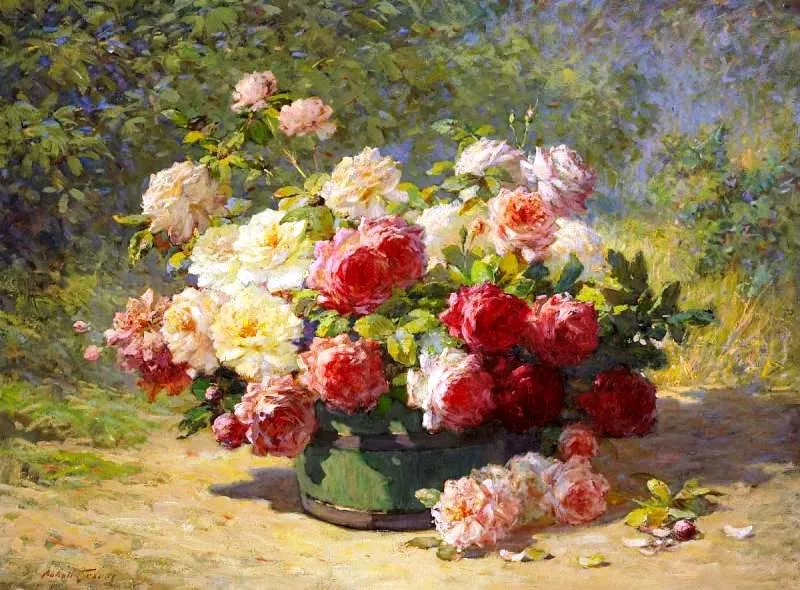
That may be one reason these works remain easy to approach today. Their subjects are familiar, but Graves's compositions encourage us to notice the relationship between things that we normally see separately. A house is not simply a house when its doorway opens onto a garden. Flowers are not simply flowers when they are placed against a wall or beneath a window. The character of the scene comes from the way these elements occupy the same space.
In this respect, Graves's garden paintings sit somewhere between still life, architecture and landscape. They borrow the concentrated color of the flower painting, the structure of architectural composition and the changing light of outdoor landscape, without belonging entirely to any one category.
The doorway remains one of his most interesting devices because it holds these elements together. It marks the edge of the house but also opens toward the garden, allowing the painting to contain both enclosure and distance within a relatively small space.
For anyone looking closely at Abbott Fuller Graves today, Doorway and Garden offers a useful place to begin. It shows why his reputation as a flower painter tells only part of the story. His real subject was often the cultivated world around the flowers, where architecture provides order, gardens provide color, and changing light brings the two together.
Art Curator & Garden Historian
Eleanor Graves Whitmore grew up in a New England family where peonies, roses and wisteria were treated almost like relatives, the same flowers that Abbott Fuller Graves painted again and again. With a degree in Art History from Smith College and further study in Botanical Illustration at the New York Botanical Garden, she follows the places where painting, plants and domestic life overlap.
Her essays for abbottfullergraves.org read less like academic papers and more like letters from a friend, wandering through color, light and memory in a sunlit garden. Her work has appeared in The American Gardener and Fine Art Connoisseur and when she is not writing, she is usually outside, coaxing old heirloom roses back into bloom in her Massachusetts backyard.
Editor: Abbott Fuller Graves Estate Archives
Contact: [email protected]